
3rd declension nouns will always follow this pattern of word endings, based on their case (place within the sentence) and number (whether it is singular (just one of the thing) or plural (more than one of the thing)).
Unlike the 1st and 2nd declension, 3rd declension nouns can have a variety of endings in the nominative or vocative singular. After that, they all follow the same pattern.
In the 3rd declension, there are two patterns a noun could follow: m/f or n. These will be explained further later on. The only difference is that some 3rd declension nouns (n) use -a for the nominative, vocative, and accusative plural cases, like in the 2nd declension. All other endings are the same.
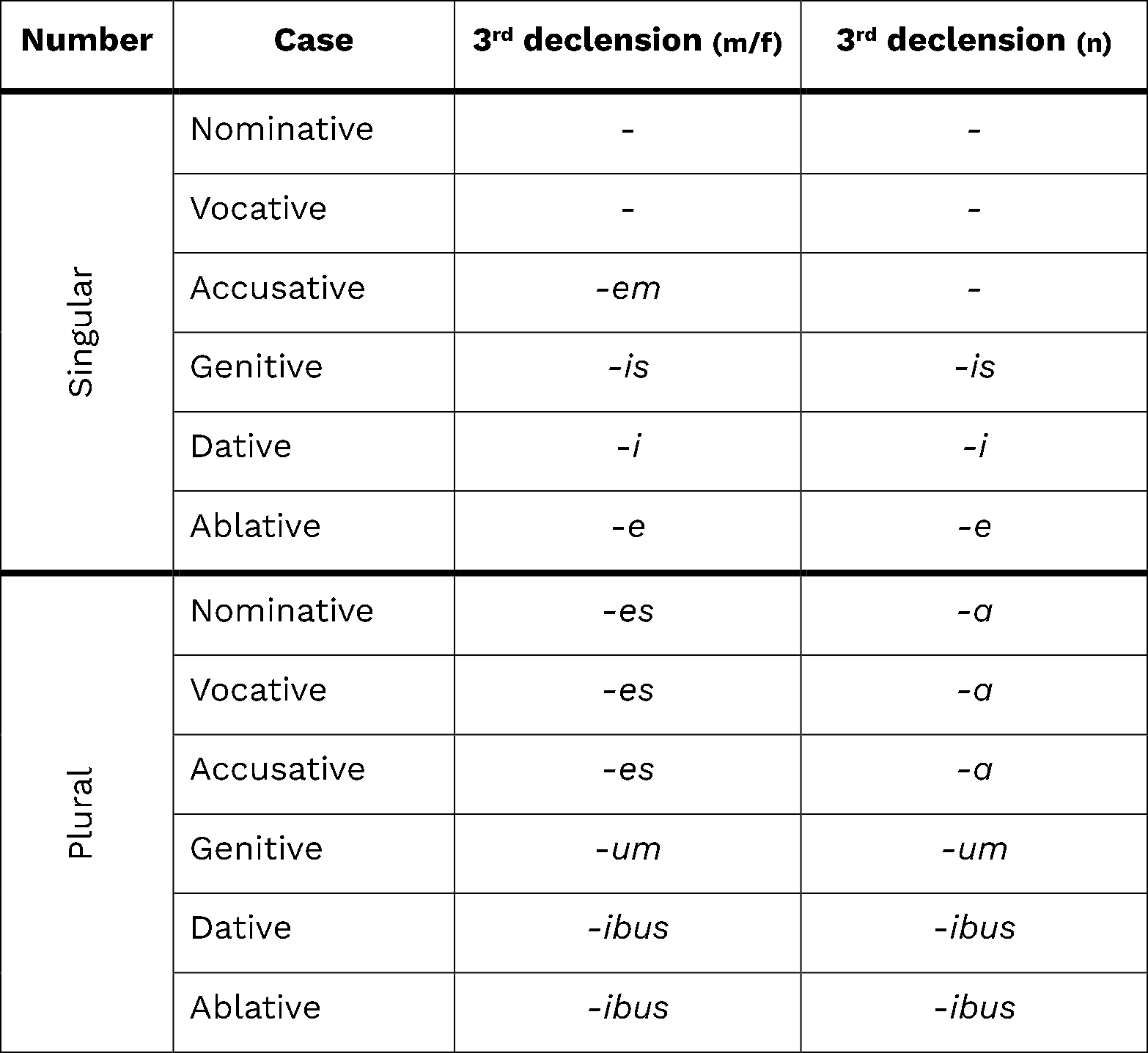
If we use the example of the 3rd declension (m/f) noun mercator (‘merchant’), based on its place in a sentence, it would look like this:
Singular
mercator - the merchant does something
mercator - addressing the merchant
mercatorem - something happens to the merchant
mercatoris - of the merchant / the merchant’s something
mercatori - to/for the merchant
mercatore - from/with the merchant
Plural
mercatores - the merchants do something
mercatores - addressing the merchants
mercatores - something happens to the merchants
mercatorum - of the merchants / the merchants’ something
mercatoribus - to/for the merchants
mercatoribus - from/with the merchants